
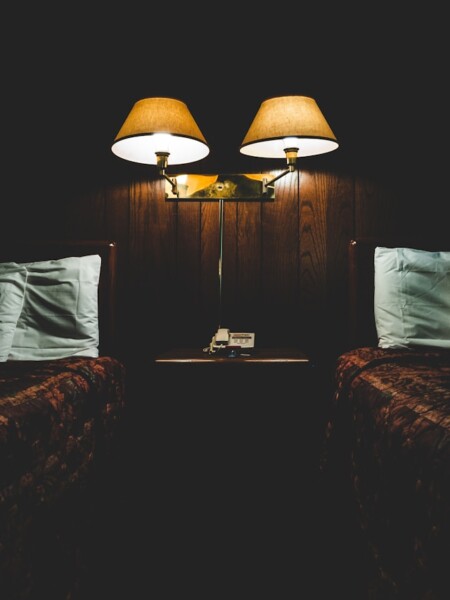
Philadelphia Hotel
The walls here are like saltines. From the far end of the king-sized bed I hear the elevator ding as clearly as if I was in it.
“I’m taking the stairs!” laughs the woman from across the hall. “I’m not fucking with that shit in a power outage.”
“This is fucking bullshit,” I hear a male voice reply, cheerfully. He’s having fun. “$89 a night for this?”
You ask me what I think of the place. “Is this blood?” I ask, surveying a smudge on the door with my cellphone flashlight.
This is just how Philly is, you say. “It’s practically Calcutta.” Something guilty and white inside my flinches, but you’ve been to India five times, when you were a Hare Krishna, and what the fuck do I know. “I don’t know if this is what Philly is like,” I say. “We almost never lose power at my house.”
I live here, in Philly, and you live in Boston, a city I’ve made it a part of my personality to hate. You’ve stayed at this hotel many times without incident, you know the lady at the desk. You joke to her that this is your home away from home, and she gives you some toothpaste samples, because the gift shop is closed. “The packaging on these is so wasteful,” I say, standing in the dark bathroom. “What?” you say. I place a hand on the cold formica counter. I think it might feel nice – “grounding” – to lay my face against it, but I do not.
I point out that the two photos, black and white landscapes, side-by-side on the wall, are exactly the same photo, and the side table is so scratched up that in a certain light it looks like it’s covered in coarse little hairs.
The power will be out for many hours, and you press your cool forehead against my neck and we lay in silence in the dark, and through the window I watch lights blinking on a not-so-far-away bridge.
I feel like there’s a lot I can learn about you and from you, about love or more likely how relaxing the absence of it can be, or maybe not the absence of it, but love without all the stomach pain and the nauseous highs and the brutalizing lows. A love characterized by something that feels, for the moment, like total freedom, freedom from inconvenient feelings, from jealousy, from “does he or doesn’t he?,” from all the things that make love exciting and awful, from the parts that have inspired art through the ages, the parts that have compelled me to watch Sex and
the City all the way through five ( six?) times. It’s been a total of three months and 15 days since we “started messaging” – friends of friends, we are – and we’ve been in this hotel for one week and the math has come out oddly and it feels as though we’re two, maybe three years in. In other words, we know each other. We think we do.
But of course it’s not really like that, it’s still only week one. We’ve never been angry at each other, though I do see flashes of the anger you’re capable of, directed elsewhere.
The bathroom is too echoey and the lock is broken and you can hear everything and it makes me shy for once in my life. I ask you to talk while I pee so that I can relax. You read me funny Tweets and I can’t quite hear you, but the slightly muffled sound of your voice — so familiar from the voice memos, and the phone calls, and from that YouTube interview you did that I secretly watched three times so that I could see how your face moved and how it matched that gruff, throaty New England accent — does the trick.
I’ve never envisioned what our relationship would be after this week, it’s impossible for me to imagine. But obviously that’s not totally true, I did swear to you that in two years – if we’re both still alone — I’d force you at gunpoint to marry me.
“I mean, I don’t want to sound crazy,” I said.
“That does sound crazy,” you said, “but, fine.”
Two weeks later you send me a text: “There are a million jigsaw puzzles and these people are all mavens.” The darkness you’d seen creeping under the hotel doors has overtaken you, and you let your dad and your sister take you to an inpatient facility where they feed you lithium and tell you there was not much to hope for in terms of non-medicated “recovery.” You’re allowed to have your phone just once a day, and you text me: “Gotta make this quick, but they won’t let me leave.”
It’s almost a relief to not talk to you, after months of late nights and early mornings with you, with my phone. Before you left for the hospital you texted me, “I’m so sorry for what I’ve put you through.” You’ve put me through almost nothing, and that makes me a little sad. Part of the liberation from ecstatic love is the liberation for heart-rending pain. But that doesn’t feel right. In some ways this all seems contrary to our deal. I should feel like a spouse waiting for you on the other side of this inpatient ordeal, when you will emerge with a scary and overwhelming diagnosis.
On the weekends the security is lax and you steal your phone from the office and hide it in a book about Samurai, like a child hiding a comic book. It makes me feel like a kid, this illicit talking.
You like your roommate. He’s around 20, gay, and works at Starbucks, that last detail being a big plus in your book. You like the staff too, you can hardly believe how they manage to maintain their patience and grace in the face of all these furious or catatonic or weeping people. The doctors, though, you don’t like, though you wonder if there’s sexual tension with your primary specialist, a woman who you can’t help but find sexy in her stern refusal to coddle.
“I’d like to sneak a girl in here,” you tell me, and recount our hotel week with exaggerated erotic detail, and I play along with your suggestions of future threesomes – how will we find another woman, when we both have such wildly different tastes? – and join in as you imagine what kind of young man I should find for myself, to tell you all about, as if you’ll be in this bright, thin-walled hospital forever.
Of course you will not be. When the kind orderlies and rude doctors are done with you, your feverish texts will come at a slower and more sensible rate. You will need me less, and you will need your memory of me, of our week in the hotel, less. You will no longer wonder how you’d handle the tidal wave. You’ve been instructed to visualize the ocean and it is now calm.
But this crummy hotel room has watched an entire marriage unfold. It must look like one of those sped-up nature videos, flowers blooming and wilting at a frantic pace, the wedding-night sex that hardly has time to be new, the 4 a.m. conversations that within days give way to me, sighing in benadryl-sleepiness and you, mutterering under your breath at the Celtics game that you’re watching on your phone. In the morning, you leave to go do the work that brought you to town in the first place; I sit in the mess of white hotel bedding and work on my laptop, and wait for you to come home.

Margaret Welsh is a Queens, NY based music journalist with bylines at Bandcamp, Dusted, Women in Sound, and elsewhere. Read more at Margaret’s Newsletter | Substack