All the Time About You
Vladislav Khodasevich is not a household name in the West, though he should be. One of the most precise and devastating Russian émigré poets of the twentieth century, he believed that truth — even the kind that wounds — was worth more than any “elevating illusion.” He wrote about others with this ruthless clarity. And when it came to love, he wrote about himself the same way.
His last great love was Nina Berberova — later known in America for her autobiographical prose, but in the 1920s she was simply a young woman who adored him. They met in Petrograd in 1921. She listened to him read from his new book, touched his sleeve afterward, and kissed the cover of the copy he gave her. Something in him shifted. Something in her ignited. Within months they left Russia together — Berlin, then Paris, poverty, illness, shared work, shared notebooks, shared breath. He once wrote to her: “You are my life.” And he meant it.
But love, even the kind that saves you, can also hollow you out. After 1927, after his last book of poems — a dark, prophetic volume called European Night — he stopped writing verse almost entirely. All his strength went into her, into criticism, into survival. She remembered his fears: poverty, humiliation, the world itself. He leaned on her more than he ever admitted. She carried more than she ever said.
And then, in April 1932, she left.
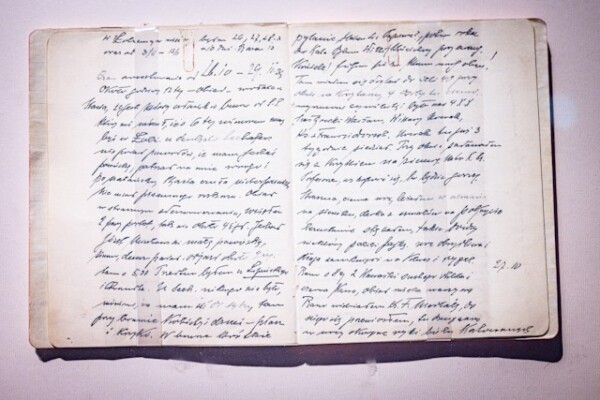
He recorded it in his diary — a meticulous daily log he kept with almost bureaucratic precision: “At 5:10 p.m. N. left.” A single line, separated from the others by two long dashes, as if the page itself held its breath.
She had cleaned the apartment before going. Cooked soup for three days. Mended his socks. Left everything in order. He watched her get into a taxi and didn’t try to stop her. Afterward came depression, thoughts of suicide, letters written almost daily. He arranged meetings where both of them brought their new partners, just to be near her. He couldn’t let go.
In one letter he wrote: “Now I have nothing. Not even Pushkin. Not even my poems.” In another: “What happiness it is — to write nothing.” As if love had burned through the last of his creative light.
But he kept writing to her. For seven more years. Until January 1939.
And then, in June, dying, he dictated his final words to her: “All the time about you, day and night only about you… You know yourself… How will I be without you?.. Where will I be?.. Well, it doesn’t matter. Only you be happy and healthy. Drive slowly. Now goodbye.”
That mixture of tenderness, despair, and everyday care — drive slowly — is what undid me.
When I first read the line in his diary — “At 5:10 p.m. N. left” — I felt the silence more than the words. The space between them. The breath held by the page. The truth he demanded of others finally turned inward, and what remained was not the poet, not the critic, not the émigré intellectual, but a man who loved someone so completely that her leaving became the axis around which the rest of his life slowly dimmed.
He wrote about the dead with merciless honesty. But in the end, he became the most honest chronicler of his own heart.

Anatoliy Loginov is the Grand Prix winner of the All‑Russian literary competition “Ecology of the Soul — 2026” and a selected resident of the Writers’ Creative Residency in Svetlogorsk. His work appears in Asymptote, Rowayat, Space and Time Magazine, The Rome Review, FlashFlood, and others.