

A Room With Clean Sheets
We have maybe ninety minutes.
Vera knows a place — she always knows a place, which is one of the things about her I’ve stopped asking questions about. A motel off the service road behind the mall, the kind that rents by the hour without judgment and at least changes the sheets between guests.
She’s already there when I arrive.
Of course she is.
She’s sitting on the edge of the bed with her shoes off, coat folded over the chair, holding a gas station coffee in both hands like it’s the only warm thing in the world. The room is aggressively beige. A painting of a lighthouse hangs slightly crooked above the headboard.
Neither of us fixes it.
***
“I don’t love you,” she says.
Not cruelly. The way you’d read something interesting aloud from a newspaper.
“I know,” I say.
“I mean it.” She takes a sip of the coffee. “I love Michael. Badly, and with a lot of complicated feelings about it, but I love him.”
“I love my wife.”
“I know you do.”
We sit with that.
Outside, someone pulls a rolling suitcase across the parking lot. The wheels catch every crack.
“So what are we doing here?” Vera asks. Not for the first time. Not with any expectation that this time will produce a better answer.
“I don’t know.”
She nods slowly, as though that confirms something.
***
We don’t spend the ninety minutes the way you’d expect.
Or we do, for a while. But that part is almost beside the point — something we move through on the way to the actual thing, which is what comes afterward: shoes off, backs against the headboard, the crooked lighthouse presiding over us from its permanent list, talking.
That’s the part I can’t explain to anyone.
That’s the part I can’t explain to myself.
She tells me about her mother’s last visit and the specific exhaustion of being perceived incorrectly by someone who loves you. I tell her about the project at work unraveling in slow motion and the performance of confidence I maintain daily in front of people who can’t know.
We talk about our children with the careful tenderness of people handling something irreplaceable.
We talk about our spouses the same way.
***
“I’ve thought about it,” Vera says at some point. She’s tracing something invisible on the sheet. “Why we do this. I’ve made lists.”
“What kind of lists?”
“Reasons. Justifications. Explanations.” She abandons the invisible tracing. “They’re all true and none of them are sufficient.”
“What’s the best one?”
She thinks about it.
“You don’t need me to be anything,” she says finally. “You don’t need me to be happy or consistent or fine. You don’t have a version of me you’re protecting.”
I understand that more than I want to.
“For me,” I say, “I think it’s that you know the thing I actually am. Not what I present. The thing underneath the presentation.”
“That’s the same thing,” Vera says.
“Yes,” I say. “I think it is.”
***
We’re risking everything.
We both know it. We’ve said it to each other in different ways at different times, and the saying of it never makes it feel more manageable. Two marriages. Her kids younger than mine. My job, where reputation matters more than competence half the time. Her husband’s temper, which she’s mentioned twice with a careful neutrality that suggested more than it said.
All of it sitting in the parking lot while we’re in here.
“Do you think we’ll stop?” she asks once, pulling her coat back on, the ninety minutes spent.
“I think we’ll stop,” I say. “Eventually.”
“That’s not reassuring.”
“No.”
She checks her lipstick in the mirror above the dresser. Something she does without self-consciousness. A small private ritual I’ve memorized without meaning to.
“The thing I can’t stand,” she says to my reflection, “is that I don’t feel guilty.”
“I feel guilty,” I say.
“About what, specifically?”
I think about it honestly.
“About not feeling guiltier,” I say.
***
She laughs.
It’s a real laugh — unguarded, slightly surprised at itself, the version that doesn’t know it’s being watched.
It’s the version I’d miss most.
That’s the part I never say out loud.
Some things you understand and keep. Like a stone in your pocket you don’t show anyone but can feel the weight of any time you reach in.
She kisses me once at the door. Practical. Conclusive.
Then she’s gone, coat and coffee and ash-blonde hair, leaving the room with the competence of someone who has already decided not to look back.
I straighten the lighthouse painting on my way out.
It makes no difference.
But I do it anyway.
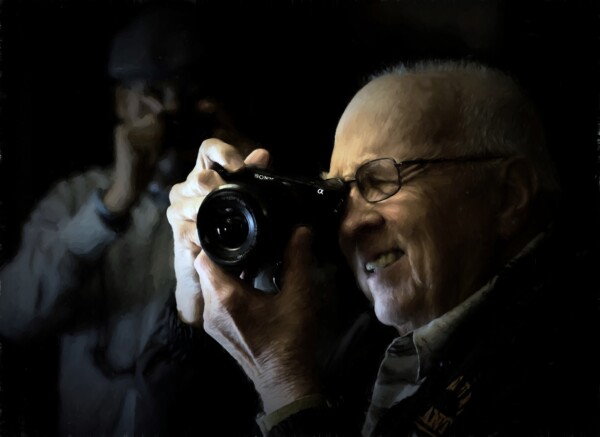
Dale Scherfling is a fulltime writer/poet and a creative writer and photographer instructor. He is a former newspaper sportswriter, editor and photographer and retired U.S. Navy photojournalist. His work has been accepted by The Monterey Poetry Review, San Diego Poetry Annual, Chiron Review, Mangrove Review, Letters Journal, The Blotter Magazine, 25:05 Magazine, Discretionary Love, Writing Teacher, Third Act Magazine, Yellow Mama, Close to the Bone, Flash Phantom, Dispatches Magazine, Five on the Fifth and Oddball Magazine. He is the recipient of three U.S. Army Front Page Journalism Awards and is also a college lecturer and instructor of photojournalism, photography, and music.