The Truck
As the son of a nurse, I spent many summer afternoons at my granddad’s house while Mom worked long shifts at the hospital. Granddad’s house was a lot smaller and older than ours, having been built sometime in the late 50s. The floors of the house were covered in a thick, green shag carpet that reminded me of the grass from a Saturday morning cartoon, and every wall was covered in a vintage Weldwood wood paneling, decorated with a gallery of black and white photos of a young man standing beside his mud-covered pickup truck.
“Who’s that?” I asked, pointing to the man in the photo.
Hoisting his large body from his armchair, he walked over to me and lifted me up towards the picture.
“That’s me, Dusty. That was back when I used to race trucks—mud bogging is what they call it.”
“Were you any good?”
“Was I any good?” he said with a chuckle. Carrying me into his room, he sat me down and pulled a large cardboard box out from underneath his bed. In the box was a large collection of old trophies and medals, many with trucks on them. Looking over the trophies, Granddad’s eyes began to sparkle, and for a moment he seemed twenty years younger.
“Yeah,” he said with a childish smirk. “I was pretty damn good.”
Eager to pass down his skill and passion for driving, Granddad decided that, even at the young age of eight, it was time for me to learn how to do it.
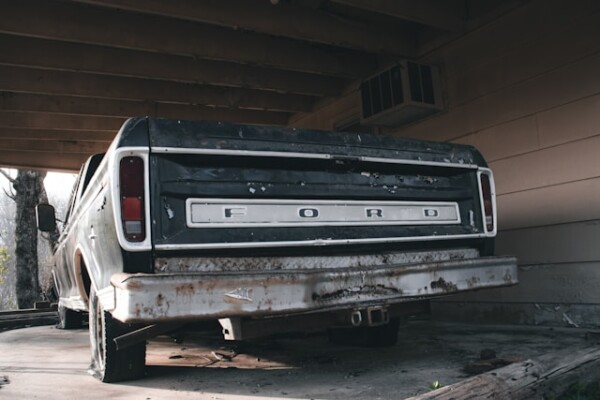
Outside his house was a large, metal shop, and in that shop was his old white- and blue-striped 1984 Ford pickup. The only thing that wasn’t blue in the interior of that truck was the black carpet flooring. Everything else, from the doors to the dash to the long leather seat, was a bright electric blue. Sitting at the wheel, Granddad placed me onto his lap and gave me a long and overly complicated explanation of all the truck’s controls, an explanation that probably would’ve been too complex for a teenager to understand, let alone a little kid. From there, we spent the rest of the summer driving up and down the hill of Granddad’s neighborhood.
Spending those summers at Granddad’s house and driving around with him in that old pickup were among some of my fondest memories as a child. But those summers were now distant memories of happier times. Seasons change, grandsons grow older and go off to college, pickup trucks break down, and so do granddads.
While away at school, Mom had called me one evening to tell me that I needed to come back home to visit Granddad. It had been a little over a year since I last saw him. Gone were the leisurely days of childhood where I could spend all day with him driving up and down the hill or working with him in the shop; now there were classes to attend and late-night shifts to work, and road trips too long to make on a weekend.
“I’m worried about him, Dusty. He’s not well,” Mom said. How could Granddad—that big, strong hero of my youth—be unwell?
“Next week is fall break,” I replied. “I can go see him then.”
The first day of fall break, I left and began what felt like a never-ending 20-hour drive from Midtown, Detroit, back home to Sheridan, Wyoming. No feeling of relief could’ve ever compared to the one I felt turning into the cracked street of Elliot Rd., down the hill to that old house I knew so well. Even as a boy, Granddad’s place had always felt like home.
Pulling into the gravel driveway, I could see Granddad, busy at work on one of the wooden tables in his shop.
“Is that my Dusty I see in the driveway? Get in here, boy, and come give your granddad a hug!” he yelled out from the shop.
Standing up from his work chair, I saw Granddad, or a frailer-looking version of him. What once was a larger, broader frame was now a thinner, hunched-over silhouette. Standing in front of him, I noticed his bright blue eyes appeared more dim and gray, while his once rounded face looked more thin and worn.
“Hey, Granddad. How are you making it?”
“I’m fine, son. Doing just fine,” he said, walking back over to the table. Next to it was a familiar cardboard box filled with the medals and trophies from all those years ago.
“You remember these?” he asked, with that same childish smirk plastered across his face.
“Of course, I do.” Picking up one of his trophies, I glanced at the bottom inscription, which read: “Mud Boggin’ Mania Race 1st Place Winner.”
“I won that one back in ‘76 in Saint Jo, Texas. My time was around 4.2 seconds, the fastest mud race any of those folks had ever seen. For years, your mom, grandma, and I would
travel all around the country for those races,” he replied, his voice now lowering. “But that was years ago, back to a time when I didn’t have to go to a thousand doctor appointments a week.”
For the next few moments, the two of us sat together in silence. With a bottle of Brasso Metal Polish and a steel wool pad in hand, I watched Grandad’s leathered hands tremble and shake as he tried to polish away the years of age and neglect off the trophies.
That night, Granddad and I ate a dinner of leftover steak and instant mashed potatoes and stayed up late catching up on the events of this last year. The house hadn’t changed much since I had last been there; then again, Granddad was never one for change. The same green shag carpet—now slightly darker—still covered the entire floor of the house, and the walls still had their same wood paneling from before. The only difference now was that there seemed to be even more photos of a younger Granddad. An evergrowing shrine to his so-called glory days.
The next morning, I awoke to find Grandad putting on a pair of his starched khaki pants, the kind of pants he would only wear to three things: church services, funerals, and doctor’s appointments.
“It’s not Sunday, so who died?” I joked, standing at the doorway of his room. “No funeral, I have a doctor’s appointment today.”
“I didn’t know you had one today. Give me a minute to brush my teeth, and I’ll go with you,” I said, walking towards the bathroom.
“No need, Dusty. It’s not important anyway. You stay here and rest; I know you’re still tired from yesterday’s drive up here.”
Granddad seemed insistent, but just like him, I was stubborn too, so after a couple of minutes of going back and forth with one another, it was settled; I was going with him.
Even after all these years, I was never able to get used to the fact that Granddad did not have his old Ford pickup anymore. His new truck was one he had bought a couple of years ago as a retirement gift to himself. It was a newer model, complete with a touch screen, blind spot detection, and a backup camera, something that my 2011 Dodge didn’t even have. Sitting in the truck, I watched as Granddad struggled to back out of the shop, the motion detector alarms sounding off as he was inches from backing into a wheelbarrow.
“Why don’t you let me drive, Granddad?”
His face tensed. Granddad was never one to ask anyone for help, but looking at the backup camera and seeing the wheelbarrow, he slowly nodded his head. It wasn’t until I began around the front of the truck that I noticed a large punctured hole in the front bumper.
“Woah,” I shouted. “What happened here?”
“Someone must’ve backed into me with their hitch, or something. Look, if we don’t hurry up, we’re going to be late to this appointment.”
Climbing into the truck, we left the shop, now driving towards the doctor’s office thirty or so minutes outside of town. We didn’t talk much on the drive up there, only about how much Sheridan had changed since I moved away. Upon our arrival, we were met with a giant sign reading: “Sheridan Neurology.”
“You didn’t tell me this was a neurology appointment.”
“You didn’t ask,” he smirked.
Inside, the waiting room was no different from any other waiting room of a clinic. The walls were white and decorated with cheap art, probably from a local T. J. Maxx. The tile floor was dirty and aged, with noticeable years of wear and tear from thousands of doctor visits. The chairs were stiff and uncomfortable, which only added to the misery of every other bored-looking patient in the room. Hanging on the wall, near the check-in desk, was a flatscreen playing old reruns of Dr. Phil, which was the only noise that could be heard in this sterile snooze-fest of a waiting room.
It wasn’t too long of a wait before Granddad and I were finally called back into one of the rooms. Sitting up on the bed, I watched as the trembling in his hands began to worsen.
“Are you nervous or something?” I asked.
Granddad looked down at his trembling hands, his face tightening. “No, I—”
Before he could finish his statement, the neurologist walked into the room, clipboard and papers in hand. The doctor was a short, older man of Middle Eastern descent.
“Hello, Charles,” he said. “How are you feeling today?”
“Fine, Doc. I’m doing alright.”
After a short introduction between myself and the doctor, I watched as he walked over to Granddad, gently grasping his hands.
“The trembling is worsening, isn’t it?”
Granddad just looked away, ignoring the doctor’s question. What followed was a physical examination by the doctor, testing Granddad’s reflexes and mobility. Gone was the racer with the cat-like reflexes to shift gears; now, sitting in this office was a slow, trembling old man. After a couple of silent, suspenseful moments of writing on the clipboard, the doctor, looking at Granddad, said, “I hate to tell you this, Charles, but you have the symptoms of Parkinson’s Disease. I want to go ahead and schedule you for an MRI, just to be sure, but I’m pretty certain that’s the cause of all of this.”
Granddad sat silent and motionless, nodding his head as if he already knew the neurologist’s answer before the words tumbled out of his mouth .
The drive back to Granddad’s house was mostly silent, as the word kept ringing in my ear like a bell: Parkinson’s. Looking over to the passenger side of the truck, I watched as Granddad stared out the window, watching the rows of trees lining the side of the highway.
“I used to be something, Dusty. I was young and strong. I was a winner. But then there’s that word: was.”
“No one backed into the front of the truck, did they, Granddad?”
“No, that was me.”
“Have there been other accidents?”
Granddad nodded his head. “Your mother worries. She wants to take my truck away, but she doesn’t understand. I can’t race anymore, but if I can’t even drive at all, who will I be?”
“You’ll still be my granddad.”
Turning into the neighborhood, at the top of the hill, I reached over, placing Granddad’s hand on the steering wheel next to mine.
“How about we drive up and down the hill a little, just like old times?”
Granddad smiled, and for the first time in years, I saw that same sparkle in his eyes as I first saw years ago. And for a split second, he looked a little younger.
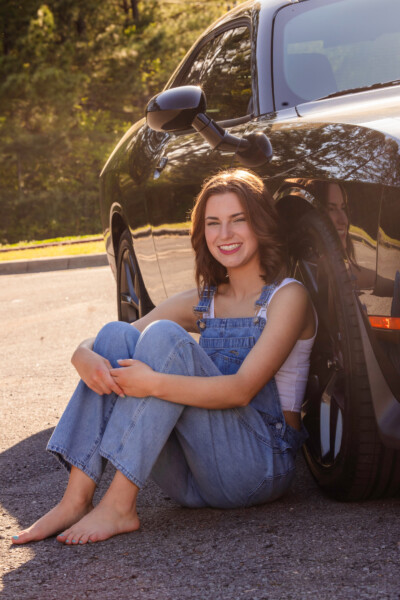
Haley Helton is an artist, writer, and dreamer in pursuit of becoming a published screenwriter and novelist. A graduate student at the University of Central Arkansas, Haley works as an adjunct professor at the university teaching Intro to Creative Writing. Outside of writing, Haley loves to spend her time being with her family, taking her husky Max on long walks, reading, drinking copious amounts of tea, and watching old science fiction series such as The Twilight Zone and Star Trek.