Two Eulogies
Celia Jeffers stood at the front of the viewing room, watching the people file in. They came in slowly, with the hesitancy of the aging, warily entering a too-oft-visited funeral parlor.
Her mother’s body lay in the casket, hands folded across her chest, mouth set in the same disapproving frown she favored when Celia said something off-color at the dinner table. The frown looked natural on her. A life reflected in that single expression of reserved disappointment.
For her entire adult life, Lydia Jeffers had gone daily to the same church. Celebrated a clean house and life. Gloried in a well-kept lawn and flower beds. Washed dishes with determined ferocity. Aggressively opposed any form of new technology. Possessed a Hoover vacuum which was permanently stored in the coat closet. She preferred the old straw broom. Tolerated, but seldom used, a land-line telephone. Cell phones, never to be touched, were the tools of the devil. Computers a spy from the government. She talked through the screen door to neighbors about the downfall of the nation and the coming rapture. They said she was a woman of principle. Which meant she was constupationally reserved and stubborn as a post.
Celia waited until the funeral director had finished his announcements, part well-rehearsed empathetic-laden sadness and part advertisement for future business, then she stepped to the podium. As she did, Elizabeth Allen arrived, hesitated in the doorway, adjusted her skirt, sat in the last row.
Bethy hadn’t changed much. Hair pinned up and still the color of straw. Her eyes met Celia’s and she smiled briefly. Celia felt the room brighten. She began her eulogy.
She read from notes written in her hotel room the night before. Finishing only after a bottle of wine, and hours of staring out a window at a single lamp lighting an empty street. She said things people wanted to hear. Good mother. Faithful wife. Churchgoer. Volunteer. Strong spirit. Celia kept her voice steady and even.
Mourners nodded that careful nod of church goers, appearing to agree, while reserving the right to disapprove. All they really wanted was to hear the words from one of their own. To celebrate their memories of Lydia Jeffers. To them, Ceilia wasn’t and didn’t.
When the ceremony ended, people whispered words of sympathy. She smiled and thanked them. She could feel the distance in everything they said – and didn’t say. She could have done more for her mother, been a better daughter, lived closer, visited more frequently, lived differently. Mercifully, they kept it all in their eyes rather than their mouths.
Then came Elizabeth’s turn.
They hugged.
“You look… good,” Elizabeth said, stepping back.
“You look like yourself,” Celia responded. “I’ve missed that.”
They stood – pausing awkwardly, smiling like people who knew each other too well to pretend, but had forgotten how to be comfortable together.
“I’m sorry about your mother,” Elizabeth said.
“Thanks. I appreciate it.” Celia exhaled. “I’m glad you came.”
“I wasn’t going to miss seeing you,” Elizabeth said. “I know things weren’t… simple between you two. But she was your mother.”
Celia nodded. “She was something. I’ll give her that.”
Elizabeth’s eyes softened. “Do you have time later? To talk?”
“Yes,” she said. “Where?”
“The nature park,” Elizabeth suggested. “Out on Route 9. Nobody goes there on a weekday.”
“Two o’clock?”
“Two,” Beth agreed.
They smiled again. Lighter this time. Celia watched her go. Felt a knot tighten in her stomach.
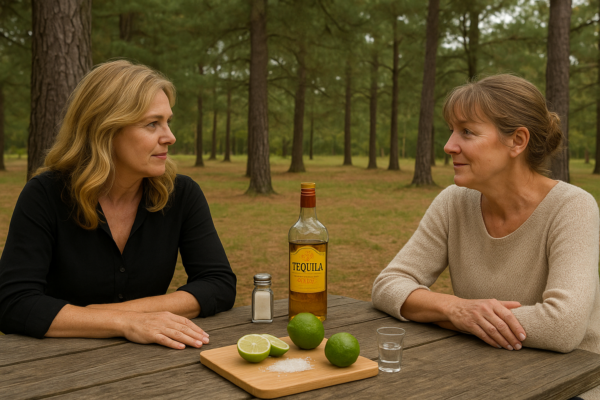
At two that afternoon, the sun sat high and hot above the pines. The nature park was quiet. Shed of her mourning outfit, Celia had regained the bright colors and suggestive exposures that were her normal patterns. “It’s good to be back to me,” Celia had thought as she reverted. She found a table under a stand of tall pines. Set out a spread – cheese, summer sausage, crackers, a bottle of wine.
She was nervous. Had something she wanted to talk about, something she had been reluctant to say aloud to her friends back in the city. She wasn’t sure how Elizabeth would take it. But Bethy had always been the friend she felt safest with, even when they were girls. Especially then.
She heard a car door close and looked up. Elizabeth walked toward her with a tentative smile. She wore jeans and a light sweater. Hugged Celia hard enough to make her sunglasses slip.
“You look good,” Celia said, laughing softly.
“You look like someone trying to seduce the trees,” Elizabeth said. Then blushed. “I mean… ”
Celia raised an eyebrow. “Bethy. Did you just make a joke about seduction?”
“I suppose I did,” Elizabeth said, embarrassed and amused at the same time.
They sat. Celia poured the wine.
At first the conversation clattered awkwardly. They talked about Elizabeth’s children, and Celia’s writing, though Elizabeth seemed embarrassed to mention any of the erotic romance novels by name.
“I tried to read one,” she admitted. “I got as far as page ten before I had to put it down.”
“That bad?” Celia asked.
“No,” Elizabeth said quickly. Too quickly. “Just… more explicit than I’d expected.”
Celia laughed. “I’m explicit. It’s what sells. Women want fantasy, mystery, adventure. Men want… well, who the hell cares what men want.”
Elizabeth laughed too, but softly, as if she wasn’t supposed to.
Eventually the conversation slowed. Not because they had nothing left to say, but because there were more important things lurking beneath the small talk.
“Look,” Elizabeth said finally. “We’ve known each other for a long time. Let’s open the boxes and get on with it.”
Celia grinned at her friend. “Why Bethy, I didn’t know you had that in you.”
“Let’s not waste the opportunity,” Elizabeth said.
“This is going to take something stronger than wine.” Celia reached into her tote and pulled out a bottle of tequila, limes, a salt shaker, and two shot glasses.
Elizabeth blinked. “Oh my.”
“You remember how we did this, senior year?” Celia asked.
“I remember regretting it the next morning,” Elizabeth said.
“That means we did it right,” Celia responded.
They drank. One shot. Then another. Their worlds loosened at the edges. Their laughter grew rounder and warmer.
By the third shot they were leaning over the table, giggling like girls, their faces flushed.
Celia wiped her mouth with the back of her hand. “All right. On the count of three, we tell each other. At the same time.”
Elizabeth hesitated. “Are you sure?”
“Bethy. I came here to talk. And you said you had something too.”
Elizabeth nodded. “All right. Three.”
“Two.”
“One.”
“I’ve started menopause,” they both said.
They stared at each other. Then laughed – hard, loud, helpless laughter.
“Oh God,” Elizabeth said, clearly relieved, “I thought you were terminally ill, or something. It’s happened to you too? I’ve been falling apart. No bowl of roses to be with. Roger thinks I’m losing it. The kids wonder why mom turned into a monster.”
“Try living with a man who reviews restaurants for a living,” Celia said. “I have night sweats. He tells me they smell faintly of cumin.”
Elizabeth snorted suddenly, covering her mouth. “Celia!”
“It’s true,” Celia said, grinning. “And don’t even get me started on sex. My body used to be a goddamn fireworks display. Now mostly it’s like… like trying to light damp matches. I’m having them all… irregular periods, hot flashes, night sweats, vaginal dryness, not sleeping. I’ve put on five pounds. I’m so wound up, I set off fluorescent bulbs when I walk by. The brain fog gets pea soup thick. I barely remember who I used to be, but who I am now seems to piss everybody off.”
Elizabeth leaned forward. “Is it really that bad? I guess I’ve been lucky. Nothing like that. It has to be really bad to put you off sex.”
“Mostly, sex is bad,” Celia said. “Then sometimes it’s okay. In weird ways. Slower. Hungrier. Then violent and intense. It’s so damn unpredictable. And the strange thoughts that keep coming. I’m forty-two, never had kids, and for the first time in my life it hit me… I never will.”
Elizabeth looked down at her hands. “I didn’t know you wanted kids.”
“I didn’t,” Celia said. “Never did. Until suddenly I did. Not children, exactly. Just the option. Knowing the door was open. Now it’s shutting, and I keep staring at it like an idiot.”
Elizabeth nodded slowly. “I guess I understand that.”
“What about you?” Celia asked. “You’re the one who always did things right. The good girl. The one with the kids, husband, and a respectable life.”
Elizabeth laughed. “I’ve been good so long I don’t know what it feels like not to be. My daughter Cleo is like you, you know. Wild. Sharp. Burning in all directions. And son Roger… well, Roger Junior lives in the basement with his computer games. Hasn’t had a date in months. On a chair that smells like potato chips and farts.”
Celia smiled. “You deserved a daughter like me.”
“Don’t say that,” Elizabeth said. “I loved you. I still do.” She blinked quickly and took another sip of tequila. “But yes. Cleo is like you. And she terrifies me.”
Celia touched her friend’s wrist. “She’ll be fine. Girls like me and Cleo always find their way.”
Elizabeth’s voice softened to a whisper. “I’m scared I’m getting old. All the really important things that made up my life seem to be fading away. I mean, I still love Roger, but more and more he pisses me off, and sometimes I wish he would just go away. But I know, if he did, my whole world would fall apart. Is that what we’re heading for… old and bitchy?”
“We’re not old,” Celia said.
“We’re beginning to be,” Elizabeth responded. “I lie awake at night, my heart pounding. Hot flashes. Mood swings. I feel like I’m coming apart. And my husband… God bless him… he thinks it’s all in my head. Or that I’m exaggerating. I lie to my friends because they’d say it’s natural. Or that I should pray.”
Celia poured them both another shot. “Welcome to the worst, and most unavoidable, chapter of womanhood.”
“I hate it,” Elizabeth whispered.
“Me too,” Celia said softly.
The tequila worked its way, loosening the words between them. They talked about their relationships. Sex. Losing desire. Losing patience. Losing the self they thought they would always be.
Elizabeth’s voice changed slowly. Less prim. Less careful. She cursed once, looked shocked, and then cursed again because it felt freeing. Celia leaned back, grinning.
“Look at you,” Celia said. “Becoming wild.”
Elizabeth laughed. “I’ve always been a bit wild. I’ve just been… respectable wild.”
“And how’s that working out for you now?” Celia asked.
Elizabeth sighed. “I want something different. Something more. I dream sometimes of… of living the life you write about. The way you live life. Like I’m still alive.”
Celia’s expression softened. “You are still very much alive, Bethy. What I write is fiction that neither of us can live.”
Elizabeth swallowed. “I don’t feel that alive.”
Celia began to grin. “Then let’s do something about it.”
“What do you mean?”
“We need a break. A real break. A week or two where we’re not wives or mothers or writers or failures or successes or anything anybody expects. Let’s be cougars. How about this? A week just for us. Where we can swim in warm water, get drunk by noon, and let some beautiful boy with dark skin bring us rum drinks.”
Elizabeth laughed. “Celia!”
“You know you want it.”
“That sounds like one of your novels,” Elizabeth said.
“I write bestsellers,” Celia replied. “People want fantasies. Women especially. Maybe a cruise. Or a Caribbean island. Sun and salt water and heat. Tell me you wouldn’t like that.”
Elizabeth looked down at the weathered picnic table. The wind moved through the pines and sent shadows shifting across her face.
“I would,” she said quietly. “I would like that very much.”
Celia leaned over the table, clinked her glass against Elizabeth’s. Grinned, and said, “Then, let’s make it two eulogies today. One for my dear, departed mother and one for what we’re leaving behind. May they both rest in peace.”
The sun slipped lower. The tequila worked its way through them until they were laughing at things that weren’t even jokes. Then lying on their backs in the pine needles, staring up at the branches. The sky a pale blue. The air smelling of pine sap and fresh grass. The wind through the pines gently rocking them to sleep.
They lay there as the shadows grew longer, and drifted into sleep, side by side like girls again, dreaming of blue water, warm breezes, and young, brown-skinned men bringing rum drinks.

Earl Smith is a published author who writes short stories, poetry, and essays focused on the human experience. Most are drawn from personal experience. He also write action-adventure thrillers – often with a paranormal twist. (https://www.smithtales.com/)