
Swallowed
The city streets had begun to empty as white powdery snow fell outside. More than sixty people had crowded their way into Merit’s Coffee—far more than it should have held. With every entry, a cold breeze cut through the crowd. All the while, Sarah Vaughan’s “But Not For Me” spilled from the speakers—low, husky, and full of longing.
Olivia Adams sat in a corner, tugging on her leather jacket, as if uncomfortable in the room. Her dirty blond hair fell limply as she stared into her coffee.
A fifty-something businessman – black tweed suit, pointed shoes – thrust his stout frame between two chattering mothers as he reached for the sugar. When he did, he bumped Olivia’s table. It wobbled on its uneven legs and coffee splashed across it.
Olivia looked up but he didn’t apologize. So, she let out a defeated sigh, then picked up a handful of paper-thin brown napkins and wiped up the spill.
“Do you mind if I sit?” An older woman with mocha skin, deep dimples, and a short afro, stood beside me. Her broad smile revealed a wide gap between her two front teeth.
Before I could respond, she settled into the chair with a friendly sigh. Then she spoke again. “I noticed you sitting here alone …” Her voice was a rich drawl, spicy like Louisiana gumbo but smooth like Tennessee whiskey. “Are you married?”
It felt intrusive. But I guess that’s what the holiday brings—friendly intrusion. Often unwanted.
I touched the gold band on my left hand. The ring used to ground me. But that seemed so long ago. “My wife,” I paused, “is at home.” I looked away – uncomfortable, uncertain and unsure of why she had asked and why I had answered.
“My name is Dorothy, by the way. My friends call me Dot or Dottie. How long have you been married?”
Olivia cut a small piece of her coffee cake and then stopped. She placed the utensils back on the plastic plate, pushed it away from her and placed her handbag on the table.
Dorothy’s eyes had followed mine. “Now that is a woman with real money, honey. Look at those shoes and that bag!” She threw her head back for a deep belly laugh. Yet she didn’t make a sound, even as her shoulders bounced up and down.
“Money,” I said, not wanting to talk but not liking her judgment, “doesn’t bring you happiness.”
“Honey, you ain’t got to tell me nothing.” She scooted her chair closer to mine and when she did, I could smell her lavender perfume. “Money can buy you a whole lotta things. But it can’t buy you happiness. The kind that comes from here.” She tapped her chest.
“You know,” Dorothy said as she scanned the room, “no one should be alone on the holidays.”
“You’re alone.”
“Me?” She clutched nonexistent pearls. “Why I’m not alone. I’m with you.” Dottie smiled more softly now. “You’ll have to forgive me. I’m just nosy. And you’ve got such a kind face. But I am waiting on someone. Are you waiting for her?”
I blinked. “Who?”
“Your wife, of course.” She tilted her head. “What is she like?”
I took a deep breath. I didn’t want to talk or think about her. Still, I closed my eyes and tried to remember.
“I’m leaving,” Dawn had said. She had been standing at the door with a single bag. She had waited — longer than she should have. We both had.”
“I love you,” I answered. But by then the door had closed.
Dottie smiled slightly when I opened my eyes and nodded at Olivia. “And do you know her? I wonder why she sits there.”
I knew why. She had lost something.
We both had.
“What are you looking for?” Dawn had asked. We were six months away from ending what had been twelve months overdue.
Her head had been resting on my chest, and my left arm wrapped awkwardly around her. The scent of vanilla, sweet and candied, had filled the room.
“Sometimes …sometimes … I don’t think I even know you anymore.”
I reached for her, but she moved further away.
I opened my eyes, not realizing that I had closed them again. Dottie stared at me with her slight smile like I should continue my story, though I hadn’t shared a word. So my mind went where it always did—back to Dawn.
I had been staring out the bay window of a little bungalow on the sandy shores of Zipolite that Dawn and I had rented. We had gone for our honeymoon and had returned every year since. On our first visit, she complained about toilets and no toilet paper and I about the lack of cell signal. But we had adored it; we had adored each other more.
This trip was “one last try.”
Just like the first time, blue water rested peacefully on the sandy beach and a gaggle of nude bathers lay sunning in the warmth of the day. Now and then, the scent of weed would casually drift by—effortless as a breeze and completely unbothered by legalities.
Dawn had walked up behind me, wrapped her arms around my waist, and laid her head on my back. “Do you ever think about having another child?”
My stomach must have knotted.
I turned and kissed the top of her head. “I think I’m going to go for a swim. Maybe nude.” I forced a smile and hers faded. “Coming?” I called as I stripped off my shirt and headed through the front door. I turned as I walked out the door before I could see that familiar sadness wash over her face. But I could feel her stare.
I could still feel it.
And I could feel Dotties’.
“Honey, do you want something else to drink? That cup is empty. “I think I need an espresso.” She didn’t wait for my response, though. She stood with the grace of an Alvin Ailey dancer and sauntered to the counter.
My attention returned to Olivia. We had met six months ago—well, I had met her—and since I had been watching her.
Just watching.
Like Stevie. Watching him.
“Where’s Stevie?”
Dawn had been sitting in the bedroom, wrapped in a white robe, reading a romance novel by an author whose books were regularly adapted for film but who seemed to know very little about love. Her hair had been pulled back and her face had been makeup free. She was as pretty as she had been at our wedding. She didn’t look up from her book. “John and Jaimie came over and picked him up. They are going to the park today. Why?” She flipped the page.
“It’s Saturday. Can’t I ask where my son is?”
She put her book down and looked at my grinning face. “I’ll give you a few things you can do,” she said. And when she stood, she let her robe slip to the floor. “Any ideas?”
“Oh a few,” I replied as I stepped toward her. I pulled her into my arms, and she wriggled off my gray joggers, and then we were both naked. I licked her earlobe, the way that always made her breath catch. And that always led to …
“Was that a knock?” she whispered between hastening breaths in my ear.
“What?”
“I thought I heard a knock.”
“It’s your …” but then the bell rang. We slipped on our clothes, giggling like teenagers just caught by one of their parents, and then I skipped down the steps to answer the door.
My buddy John, my best man, Stevie’s godfather, stood at the door wearing blue.
“Hey John! We weren’t expecting you until …”
“I’m sorry, my friend. But there was an accident …” he choked on his words and then he pulled me into his arms and hugged me. And then he sobbed. And my wife screamed. And the room spun. Round and round. And John kept repeating, “I’m sorry, I’m sorry.” Each time he did, more tears would fall. And we cried, until we had no more tears to shed. And then we cried more.
Only three years of marriage had passed.
Should I have been watching Stevie?
I looked up as Dottie pushed a steaming hot cup in my direction. “Oh, honey, I don’t know what that barista is doing.” She ignored the dampness at my eyes and guzzled a deep sip of drink and then crinkled her nose in distaste. “I asked for an espresso. I don’t know what this is.
Now, where were we? You know, you remind me of my husband. Hard worker. Dark brown eyes.” She ran a thumb across my knuckles. “The strong silent type. But a big heart. Holds things close.”
I tensed.
“Ain’t about words with men like you. No, it’s about what you don’t say.” She gave me a soft smile and then took another deep sip of her drink as if she expected the flavor to be different this time. “Oh, this is terrible!” She stood. “I need to see the manager.”
I worked a lot those last two years of Dawn and I. I needed the distraction. To be busy. Three days off and 4 days on became every day on and no days off. I was never home. And when she left, I had no reason to go home.
Six months ago, the alarm rang. A huge fire in an upscale neighborhood had engulfed one home and threatened to take the neighbor’s. Our fire department had already dispatched a truck and the second was on its way.
Usually, I can recall the details of a fire with precise details. This one I can’t. I only remember smoke, heat, and flames.
I remember my buddy Mike using a ladder to get to the upstairs bedroom.
I remember a woman screaming in the front yard, “Please help my baby.”
I remember Olivia.
I wanted to go over, to speak to her, to comfort her. But the words got in the way.
I opened my eyes, and Dorothy was talking again. “Listen, I don’t know much,” she said as she slowly stirred her coffee. “I’m just a nosey old lady whose children left the nest long ago. So don’t mind me too much and pardon my manners. But the way you keep staring at that lady, anyone would know you got something to say. Now sometimes we think the choice is to speak or not to speak. It’s not. The choice is to speak or to hold onto things that we might want to let go.”
But how could we let go?
I had gone to Olivia’s son’s funeral. I stood in the back, feeling like an intruder. But after that, I found myself checking in on her—from a distance, making sure she was okay.
She went to work, she got her coffee, then she went home. That was it.
She had stopped living life the moment her son died. And I had too, the moment mine did.
I swallowed—caught between my pain and Olivia’s. But Dorothy sat beside me nodding, as if to say, it’s time. So I took one more deep breath. Then I walked over to her table and sat clumsily.
“Olivia Adams?”
She looked up at me, startled, with misty gray eyes. A picture of her son lay on the coffee table. She covered it with her hand when I sat.
“My name is Marc. I lost my son too.” She stared at me for a moment – her eyes quickly searching my face. Then she opened her mouth as if she wanted to say, “I’m sorry.” But I said it first. “I’m sorry.”
Then she began to cry. My throat burned. Tears began to sting again. Keep it together, keep it together, I thought. But why? And then I cried too.
She hugged me before she left, and something inside me said that one day she might be okay. I walked back over to my table to Dottie who seemed to be gathering her stuff. “You did good, you know.”
I sat down hard. “I suppose I did.”
She pointed at the window. A man with a broad smile waved at her through the glass. “There he is—that man of mine. The one that reminds me of you,” she gave me a mischievous grin. “Now listen, I’m a hugger.”
And as we embraced she whispered in my ear. “You did good. But I’m sure there’s someone else who’d like to hear from you tonight as well.”
When the door closed, I picked up my phone and typed in the only number I knew by heart.
“Hello?”
“I love you,” tumbled out. “And I’m sorry, Dawn. I’m sorry I never said … I never could ..”
Silence.
And then suddenly I was babbling, “I know I should have talked. I just … I was just hurting. And I shut you out and …”
And then a catching of breath. Hers. Mine. She said, “Where are you?”
“The coffee shop on 9th.”
“I love that place.”
“Please come.”
Silence. Just a beat. Almost a sweet one. Then, “I’m on my way.”
White powdery snow fell outside the café that day. The city streets had begun to empty as the temperature dropped, and all but a few shoppers had gone home—including Dorothy and her Santa.
And I, for my part, sat patiently inside the café’s tiny walls waiting for someone to arrive.
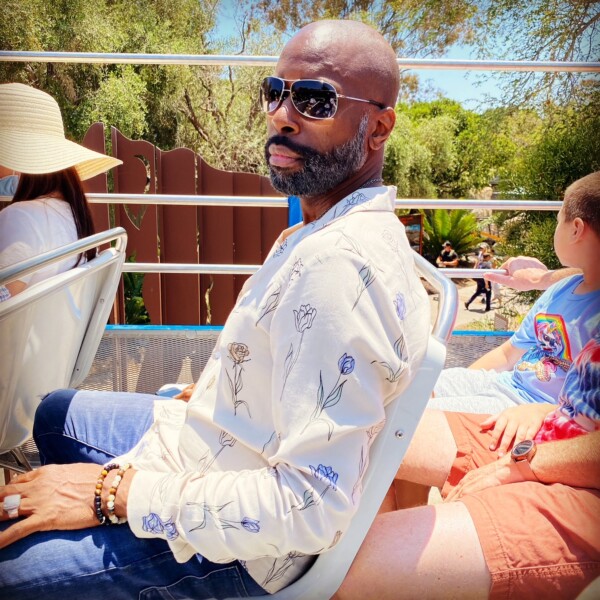
Timothe Davis is a Dallas, Texas, based author who often writes about the things that make us human: when they break us and when they make us stronger. His work can be seen or is forthcoming in Mouthful of Salt, The Brussels Review, and Story Sanctum. He spends too much time listening to Sarah Vaughan and debating his cranky chihuahua.

