
Black Swan
I first saw her at the IKEA that never closes on Van Dyke Street.
It was three in the morning. I had gone in search of a nightstand with chrome trim, no wider than twenty-two inches. I noticed her among the textiles and kitchenware, a castaway in that sterile brightness, watching me with a look that suggested recognition.
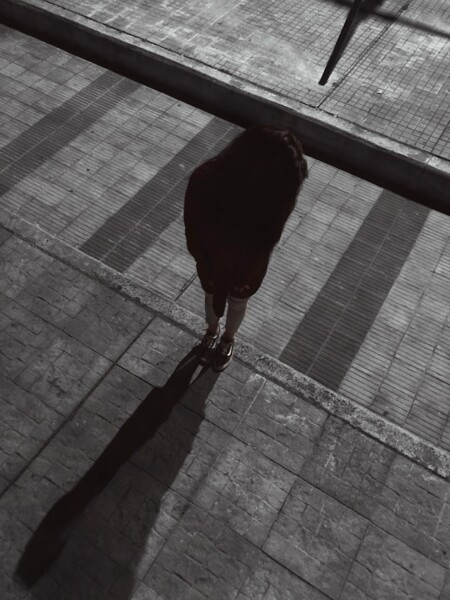
Did she follow me home that night? Someone did. A feminine silhouette, deliberate in its pace, keeping to the margins of the streetlamps as I walked back to my apartment, appearing and dissolving like a trick of light.
Two days later I saw her again, this time in the corner bodega, where I’d stopped for seltzer and AA batteries. She was waiting among the canned goods, her face arranged in expectation, as though the meeting had been agreed upon in advance. When I entered the aisle we began to circle one another in the narrow space. I looked straight at her; she refused my gaze. And yet she kept me precisely within her peripheral vision, speaking only through posture and body movements.
She didn’t follow me home that day. Not that I noticed. But near midnight, when I drew back the curtain, there she was at the corner, standing beneath the streetlamp, looking up at my window.
I called out. She turned away as if she hadn’t heard, her attention sliding down the block toward the twenty-four-hour IKEA on Van Dyke.
She returned for several nights in a row, holding her quiet vigil beneath the same lamps. By the third night—after I had dismissed her as just another deranged presence in the city—I woke in the small hours to find her in my room, standing over me as I lay in bed.
I panicked and struck her. She fell.
She moaned, calling out what she believed was my name.
“Joaquín!”
Then she really looked at me, and the certainty drained from her face. I was not Joaquín. Or so she said. I was, however, identical to him.
I felt an immediate, disproportionate remorse. Blood was seeping from her nose, reaching her lips, yet she neither cried nor made any move to leave. With an almost unearthly composure, she lifted her long, tapering fingers and wiped the damage away.
The scene struck me as profoundly strange. It also revealed her to be extraordinarily beautiful.
Her name, she told me, was Andreita. She had mistaken me for a certain Joaquín, a long-lost lover. She said she had climbed the fire escape in the hope of recovering that eternal flame.
Naturally, I doubted every word. Even the diminutive of her name—Andre-ita—struck me as contrived, a softening gesture, meant to seem less threatening, more manageable.
And yet, as we spoke, something shifted. A thought halted me: only a woman capable of a fierce, unhinged love was capable of doing anything like this.
Perhaps I had been waiting, without knowing it, for precisely that kind of impossible fervor, because I heard myself ask if she might like to stay for tea.
The tea was awful but we talked until morning, trading scraps of biography and casual remarks. The conversation, however, took on an odd luminosity, as if a deeper current were running beneath the small talk, quietly carrying us along.
When she left at dawn, I felt a faint, disorienting ache, the kind that arrives without warning and offers no explanation.
We began to see each other. I took her to popular Broadway shows and to some of the city’s better Michelin-starred restaurants, a modest gesture of reparation for the bloodied nose.
Soon enough, we slipped into a relationship. And yet it never fully shed its initial caution. It was never wholehearted. The mystery that seemed native to Andreita remained intact. The coolness, the slight estrangement, the air of reserve—none of it ever quite dissolved. She advanced only when I did, returning affection in measured flashes, like light glancing between distant mirrors, precise and fleeting.
After a few months, though, and against the advice of my friends, Andreita moved in with me. The decision, however, carried little conviction, as if we were both tacitly reserving the right to revise it later.
Questions about her past remained unanswered, the most troubling aspect being how deftly she learned to evade them. Andreita would respond to a question with another, or offer personal stories so carefully thinned of detail that they disclosed nothing at all. Her life presented itself as a vast terra incognita. I persuaded myself it wasn’t secrecy at her core so much as slipperiness—a matter of temperament rather than a malicious intent.
In time, though, that elusiveness began to sap our momentum.
One afternoon I told her I was stepping out to the bodega. Halfway down the block I turned back. In the bathroom I found her speaking in a low voice into a burner phone I hadn’t known existed.
She was speaking Chinese. Chinese. And yet she was not Chinese at all. She was Argentine—unmistakably so. Her Spanish was nearly flawless; her bearing carried that loose, unteachable Argentine grace; and she loved to tango beneath the sheets.
She turned toward me, startled. The surprise on her face appeared genuine. I asked her what she was doing. She asked me what I was doing.
When I hesitated, she pressed harder, demanding to know why I had returned so quickly, as though the burden of explanation belonged to me. The logic of the moment inverted itself.
I reached for the phone. As I did, she hurled it out the window.
“Why did you do that?” I asked.
“Why did you try to take it?” she said.
Later, I went downstairs to look for the phone. It was gone—cleanly, inexplicably—as though someone had rand removed it with intent. Someone else, because Andreita had remained with me in the apartment the entire time.
That evening I went for a long walk, all the way to the promenade. I was looking for answers. I should have ended things weeks, perhaps months, earlier. But love, stubborn as it is, had begun to take root in the cold corners of my heart. Even Andreita’s evasions had failed to loosen it.
I kept walking all the way to the Navy Yards, turning the matter over and over. Gradually, suspicion shifted inward. Perhaps the fault was mine. Andreita was, after all, a foreigner. Perhaps she was afraid. Perhaps each deflection was no more than an instinct of self-preservation, an effort to keep her balance in a place that was never fully hers. And I, in my narrowness, had quietly appointed myself both gatekeeper and tyrant.
With that uneasy thought pressing down, I turned for home. When I arrived, Andreita was gone. Gone cleanly, without residue or trace. Her belongings had vanished, even the photographs on the refrigerator. It was as though she had been an invention of my own mind, a ghost I had mistaken for something solid.
I stood there, stunned, unable to absorb the quiet disappearance of someone who had once occupied so much of my life.
The next day I spoke with my therapist. Even she could make little sense of it. She spoke instead of a black swan—an unforeseen piece of information that, once introduced, rearranges the entire narrative into a new and belated coherence.
My own black swan event arrived the following morning at work.
At the time, I was a senior engineer at a leading microchip company, the sort that prided itself on airtight systems and elegant redundancies. Over the weekend, however, we had been hacked. A trove of intellectual property—years of work, innovations, secrets, and proprietary designs—had been stolen. I learned of it the same way the rest of the country did: from the morning news. The fallout was immediate and immense.
When I arrived at work, we were herded into the cavernous conference hall. Phil, our CEO, attempted to steady the room with a pep talk. The breach, he said, carried national-security implications: some of the stolen technology was so advanced it could, in the wrong hands, be turned against the United States. The FBI and Homeland Security were already involved.
The speech was meant to reassure. For most people, perhaps, it did. I felt myself sinking into the seat.
By noon they summoned me to a smaller conference room. I already knew why. Fifteen faces stared back at me—somber, professional, quietly accusatory. The breach had been traced, and with humiliating precision triangulated, to my home computer. An unauthorized connection to the company’s main drive—my own private shortcut, created to make my work easier, a casual favor from the man in charge of online security—had become the ideal point of entry for the plunderers.
Standing there, ringed by investigators, the truth settled with the weight of a falling stone: Andreita had never been a lost lover searching for a Joaquín. She was a consummate operator, a mercenary of information—practiced, efficient, and quietly lethal.
The fallout in my own life was immense. My career buckled beneath it, each consequence mine alone to absorb. Yet even that felt secondary. The real loss was Andreita herself, beautiful to the point of distortion. I still saw her in my mind’s eye, lingering at the edge of streetlamps, beneath the sheets, standing over my bed with those fierce Argentine eyes.
She left behind enough questions to occupy a lifetime.

Albert Rodríguez is a Brooklyn-based emerging writer whose fiction has appeared in Litro Magazine USA, Five on the Fifth, White Wall Review, Platform Review, Across the Margin, BULL, Modern Literature, INK Pantry, Literally Stories, and Farewell Transmission (forthcoming), among other outlets. A graduate of Borough of Manhattan Community College, he also draws from his years working as a handyman maintaining old Manhattan buildings—a vantage that continues to shape the texture and temperament of his work.

